Teaching ESL to Adults Blog
This ESL Blog for Teaching ESL to Adults lists all the updates to this site. I'll let you know as soon as I add new worksheets, cloze exercises, and grammar tips, etc. I'll also let you know when I find other great resources for teaching ESL and EFL.
ESL Videos
ESL videos by private ESL tutor, Debra Garcia, show teachers how to conduct a Needs Assessment, what to do during the first meeting, and how to use an ESL tutoring contract to reduce cancellations.
ESL Tutoring Book Chapter One
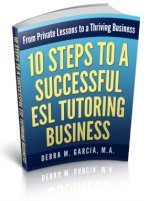
Here's Chapter One of my upcoming book, 10 Steps to a Successful ESL Tutoring Business. You can also sign up for three free videos to help you run a successful tutoring business.
What do you need to know about starting and running a tutoring business?
Wow! You guys are awesome! I've had over 30 testimonials and over 100 responses to my email announcement I sent yesterday. If you haven't had a chance to answer my burning question to you ("What are your top two questions about starting and running an ESL tutoring business that I absolutely NEED to answer in this e-book?"), there is still time. Thank you!!!
ESL Teaching Tips TOC
Table of Contents for the ESL Teaching Tips ezine. Here's the page to get all links to handouts mentioned in my ezines.
ESL Teaching Tips Ezine
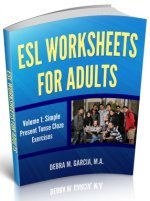
Sign up for ESL Teaching Tips and get a free ebook of 27 Simple Present Tense worksheets for English Language Learners.
ESL Worksheets for Adults is Ready!
It took longer than I thought it would, but the book of 27 Present Tense worksheets with complete answer sheets is ready.
Over the next three days, people on my "ESL Teaching Tips" email list are receiving the link to download the book for free.
ESL Worksheets for Adults, Volume 1
I'm getting back to work on providing useful stuff for my readers! I'm just putting the finishing touches on Volume 1 of my "ESL Worksheets for Adults."
Folks who have signed up for my "ESL Teaching Tips" should be receiving the volume of 26 worksheets within the next couple of weeks (hopefully sooner!).
TEFL or CELTA Certificates
TEFL or CELTA, which certification is best? Factors to consider when deciding between these two cerficates to begin your career teaching English to Speakers of Other Languages.
Voiced or Unvoiced -ed Ending for ESL
Tips and strategies for teaching how to determine between the voiced or unvoiced -ed ending for past tense verb pronunciation to ESL and EFL students.
Teaching Simple Present Verbs to ESL Students
Teaching Simple Present verbs to ESL students involves more than just verb conjugation. Form and function are also essential elements of any ESL lesson on the Simple Present tense.
Continue reading "Teaching Simple Present Verbs to ESL Students"
ESL Present Progressive Conjugation
Teaching present progressive conjugation to ESL and EFL students first requires teaching the helping verb. Lesson plans must also include form and function of the present continuous verb tense.
ESL Present Perfect Continuous Forms
Tips for teaching Present Perfect Continuous forms, verb conjugation and verb functions. This verb tense is used to talk about the duration of something that began in the past and continues until now.
ESL Past Perfect Continuous Tense
Tips for teaching the Past Perfect Continuous tense, including conjugation, forms and functions of the verb tense. The Past Perfect Continuous emphasizes the duration of an activity in the past.
Teaching Reading to ESL Students
Steps for teaching reading to ESL students and preparing effective reading lesson plans. Step-by-step list to engage students and effectively teach reading skills to English Language Learners.
Will and Be Going To for the Future
Future Simple tenses include the uses of will and be going to. The general rules are Will is used for predictions and willingness. Be going to is used for predictions and prior plans.
Resources for Teaching Adults ESL or EFL
My personal list of websites and other resources for teaching adults ESL or EFL. All sites provide valuable help for teaching adults English.
ESL Present Tense Verb Worksheets
ESL Present Tense verb worksheets are a great teaching tool and can be used to reinforce conjugation, forms and functions. Cloze exercises are common handouts used for ESL and EFL quizzes and tests.
Changes to My Website Layout
You may notice changes to the layout of Teaching-ESL-to-Adults.com over the next couple of months. Rest assured they are changes that I'm making. (When I see changes to sites, I sometimes wonder if something "bad" is happening, like someone has hijacked the site or something.--But then maybe that's just me!)
The primary reason I'm making the changes is that the incredible tool I use to make my site (SBI) is upgrading and making so many more options available to me to make an even more useful site. I will only make changes that I think will be helpful to my readers.
Your feedback is always welcome.
ESL Future Perfect Lesson Plans
Tips for Future Perfect lesson plans, verb conjugation, forms, and function. The Future Perfect is used to talk about an activity that will be finished before another time or event in the future.
ESL Future Simple Tenses
Teaching Future Simple Tenses involves teaching two versions of the tense, plus the Present Progressive tense used with a future meaning. Conjugation, form, and function must be taught.
ESL Past Perfect Lesson Plans
How to do Past Perfect lesson plans, including verb conjugation, form and function of this verb tense. The Simple Past is usually used by ESL students instead of the Past Perfect.
ESL Teaching Ideas for Past Continuous
Teaching ideas for Past Continuous or Past Progressive verbs include conjugation, form, and functions of the tense. ESL and EFL teachers must first teach the past tense of the helping verb “to be.”
ESL Present Perfect Lesson Plans
Present Perfect lesson plans should focus on verb conjugation, verb form and, especially, the functions of the verb tense. The Present Perfect has three functions in English grammar.
English Verb Tense List
Here's the verb tense list you need for teaching ESL or EFL. The basic verb tenses are Past, Present and Future, but there are a total of twelve English verb tenses that need to be taught.
Teaching Voiced and Unvoiced Sounds to ESL and EFL Students
Teaching the concept of voiced and unvoiced sounds to ESL and EFL students helps with pronunciation challanges, especially with past tense pronunciation. Vocal chord vibration is the key.
Continue reading "Teaching Voiced and Unvoiced Sounds to ESL and EFL Students"
New CELTA Locations in U.S.A.
Cambridge CELTA courses can now be taken in Los Angeles (specifically in Torrance), California and Seattle, Washington. This makes a total of eight locations across the U.S. where CELTA can be studied.
See the link below for a full list of CELTA course locations in the U.S. and around the world.
Hopefully, this disjunct is OK
Peter H. from the U.S. took exception to something I wrote on the home page of this website. While I disagree with him, the issue raises a great point about how the English language is ever-changing and constantly evolving (although some would disagree with this positive outlook!).
Peter's comment and my response follow.
Peter's comment:
"Hopefully, it will save other ESL and EFL teachers and tutors a lot of time....."
"Hopefully" is a dangling adverb in this sentence, intended to mean "I hope..." I guess there's little hope (!) of reversing this insult to English, as it has become so firmly established!
My response:
Hi Peter,
Thank you for taking the time to write. While I certainly do not claim to speak "The Queen's English" or anything like it, I will have to disagree with you on this one. I don't think the English language feels insulted by my use of this disjunct (at least I hope not!). I believe that the current state of the ever-changing English language accepts this usage of "hopefully."
You can also see a longer response about my thoughts on English, as well as another instance where someone else might agree with you about my use of English here: "Speak Like the Natives.
Welcome to English as English is used! Hopefully, I didn't ruin your day!
And I do hope (uh oh, started with a conjunction!), that none of my words here have caused any additional grief. I really do appreciate your passion and the time you took to write.
Best regards and take care,
Debra
Please and Thank You
Probably 100% of the ESL students I've met know the word "please." It's one of the first words English language learners are taught. "Thank you" is right up there, too.
When teaching students how to make requests and the various different ways to do so, I always tell them, "just add 'please' to your request and you don't have to worry about your request being in perfect English."
So here is my request to my readers who ask me for resources or ideas: please write "please" in your request.
I don't mind responding to the several emails I get every day, sometimes I even enjoy it, but I'm getting a little persnickety about the word "please."
So if it wouldn't be too much to ask, I'd greatly appreciate adding the word "please" to requests for information or help.
Thank you!
(Incidentally, many of my ESL students have mentioned that they think Americans say "thank you" a lot. Hmmm.)
Contacting Teaching ESL to Adults
I love to get your ESL questions and comments. Please remember that if you want a response from me, you must fill in your email address in the contact form. Otherwise, there's no way for me to get back to you (and I'm sure you're probably thinking I'm a flake for not responding!).
Christian-based ESL Curriculum?
I received this message from Sally in the U.S. Unfortunately, she did not supply an email address for me to answer her. Hopefully, she'll come back to my site for the answer.
Sally writes:
"I will be teaching ESL to Spanish speakers through my church. I'm excited, but nervous. I've never taught ESL.
I taught HS 20 years ago -- Media and English degrees.
I have just found your site and think it will help me. I'm open to any other help anyone wants to offer.
We don't have a curriculum or supplies. We have thought it would be good to be able to use a biblical, Christian based, curriculum. I haven't been able to find one. Any thoughts?"
My response:
Dear Sally,
That's great news, and you're right, teaching ESL is exciting. It seems that churches and other non-profit organizations are great places for non-English speakers to get low-cost or free English classes. And it also seems that these organizations are often expected to provide services with limited or no resources! That's a shame.
What and how you teach will depend upon (1) the English level of the students, (2) their age, and (3) their purpose in learning English.
You didn't mention the specifics of the first two items, but there are tons of free resources online to address the first two issues. It just takes time to find them. However, I want to address the third issue in more detail.
One thing that ESL/EFL teachers, especially teachers of adults, need to ask themselves is WHY are these students taking this English class.
In your case, Sally, is it to get a deeper understanding of the Bible or of their Christian beliefs? Or is it so that they can get a job or make advancements on their current jobs? Is it so that they can take care of the day-to-day tasks of living in an English-speaking country? Is it so that they can feel better about themselves and have more confidence in their English speaking abilities? Is it to gain "survival skills?" Etc.
The teacher has to put the students' needs first. While it's fine to approach a class from a particular orientation, in this case a Christian orientation, the lessons should be something that the students can use in the "real world," in their day-to-day lives. The material and topics covered should be transferable to the students' lives outside of the church.
I don't know of any Christian-based curriculum, Sally. You may be the person to create such a curriculum. I would just suggest that you find a way for students to transfer the English skills that they learn with you into their day-to-day lives.
Best of luck,
Debra
Do We Need Another ESL Forum?
I receive several emails every day asking all sorts of questions.
Here's a sample of what I received today:
"I work in Graduate Medical Education and have encountered very bright international physicians. However, their English skills are marginal, especially reading and comprehension. International graduates who are new to this country are also very hard to understand, especially in the rural south. Because of their advanced level of education IMG's often pretend to understand what they hear and comprehend what they read. That can be a problem in a patient care setting. Any suggestions?"
"I am an American living in New York. Is it better for me to take my teaching certification here in N.Y or to go overseas and study over there? I am confused as to which is a better option in regards to being prepared to start initially in the country I want to teach in (does this give me a better head start?) or to start here and find a job through the internet once the course is through. Please help. Thanks."
While I love hearing from readers, I find that answering these questions takes A LOT of time. Plus, I just don't always know the answers.
So here are my questions to my readers:
1. Do you think it would be useful for me to set up a forum on this website so that readers can ask me AND other readers ESL-related questions?
2. Or are there already enough ESL forums out there?
3. Would you visit and participate in a forum on this website?
Thank you for taking the time to get back to me by contacting me through the "permalink" below.
Sitemap | Contact | Privacy Policy | About
All material on this website is copyrighted (© 2007-2025).
You are free to use my materials in your classes.
I just ask that you include my website address on handouts.
www.Teaching-ESL-to-Adults.com

New! Comments
Have your say about what you just read! Leave me a comment in the box below.